Tom Tabler
Professor and Extension Poultry Specialist
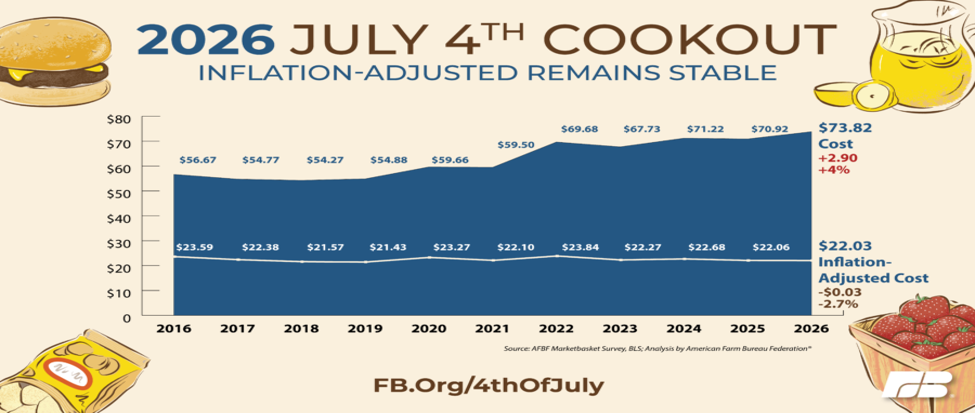
As millions of Americans prepare to celebrate the Fourth of July, countless grill masters (and countless more of us that haven’t quite obtained master status yet) across the country will be firing up backyard grills in the coming days. According to the American Farm Bureau Federation’s 2026 Summer Cookout Cost Survey, a classic Independence Day cookout for 10 people will cost $73.82, or about $7.38 per person. That is an increase of $2.90, or 4%, from last year. What this tells us is that families are seeing higher prices at the grocery store, and this year’s cookout cost is pretty much moving in line with the overall economy. This year’s total is the highest since Farm Bureau began conducting the summer cookout survey in 2016 and reflects the overall broader inflation rate that we are currently dealing with in the U.S.
While the Fourth of July cookout price is higher this year, inflation-adjusted figures provide some needed perspective. When adjusting the value using the Consumer Price Index, the cost of the food basket is $22.03 in 1982-1984 dollars, quite similar to the $22.06 observed last year. Therefore, even though we are paying more dollars at checkout this year, the purchasing power cost of the basket is basically the same as last year. Inflation-adjusted costs have remained relatively stable over the past few years and below the peak of $23.84 in 2022 (Fig. 1).
Source: American Farm Bureau Federation
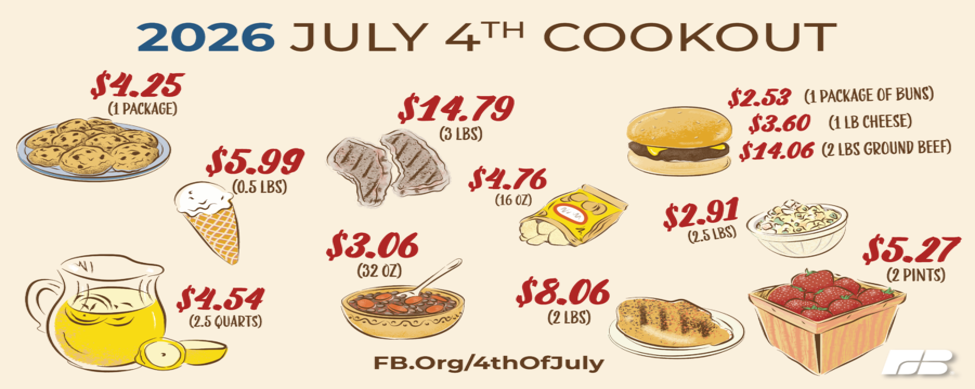
Meat proteins at the center of the picnic table are all costing more this year. Two pounds of ground beef increased 73 cents from last year to $14.06, a 5.5% increase (the highest beef price since The American Farm Bureau Federation started conducting the survey). Beef prices remain elevated as ranchers continue to face obstacles to rebuilding the cattle herd such as years of severe drought and increased operating costs. These drought conditions have reduced the size of the national cattle herd to 75-year low historic levels and tightened supplies, driving up the price of beef at the grocery store. Rebuilding the national herd will take time, and consumers should expect to see higher beef prices for possibly years to come.
In addition, the price of other meat proteins has increased. Chicken breasts also moved higher as demand has increased as consumers search for less expensive alternatives to high beef prices. Pork chops also rose as well after dropping last year. Two pounds of chicken breast now cost $8.06, up 27 cents, or 3.5%, from 2025, while three pounds of pork chops cost $14.79, up 66 cents, or 4.7%, from 2025. Staples are up as well, with one pound of cheese costing $3.60, up 6 cents, or 1.7%, from last year. Hamburger buns increased 18 cents to $2.53, up 7.7%, reflecting higher production, labor, and transportation costs (Fig, 2).
Source: American Farm Bureau Federation
Even though grocery store prices are higher, that doesn’t mean higher profits for farmers and ranchers. After expenses, farmers receive less than 6 cents of every food dollar. Most of what consumers pay at the grocery store, the farmer never sees. It goes to pay after-farm-gate costs, including processing, packaging, marketing, retail, and transportation costs. Plus, the farmer’s cost of production continues to increase. Farmers and ranchers must pay more each year for labor, fuel, fertilizer, equipment, land, repairs and other inputs; making it more difficult for farms to absorb weather disasters, animal disease outbreaks, supply chain disruptions and market volatility.
So, as you gather with family and friends for a festive Fourth of July cookout this year, throw a couple extra chicken breasts on the grill and please don’t forget to send up a prayer for all the hard-working men and women across the country that put in 70+-hour weeks to make sure that your next meal is always safe, secure, and available whenever you want it and no farther away than the nearest grocery store. God Bless our farmers and ranchers and Happy Fourth of July!