Tom Tabler1 and Tanner Thornton2
1Professor and Extension Poultry Specialist, and 2Graduate Research Assistant
Department of Animal Science
As the migratory waterfowl fall migration season begins to ramp up, commercial and backyard poultry producers need to remain vigilant against highly pathogenic avian influenza (HPAI). After only two reported HPAI cases in the entire country in July, as of October 6th, there had been 16 confirmed cases in the last 30 days. There were primarily in the northern tier of states (Idaho, Minnesota, Montana, North Dakota, South Dakota, and Wisconsin). However, in recent days, HPAI cases have been confirmed in Iowa and Indiana as migratory waterfowl continue their journey south. It is still quite early in the migration season and expect HPAI cases to increase as we move deeper into the fall migration. Maintain heightened biosecurity to protect your flocks because HPAI has not gone away. It may have slowed over the summer, but it is once again making its presence known.
Figure 1 indicates that fall migration is well underway with over 400 million birds in the air overnight on October 7th, primarily in the Upper Midwest and Northern Great Plains.
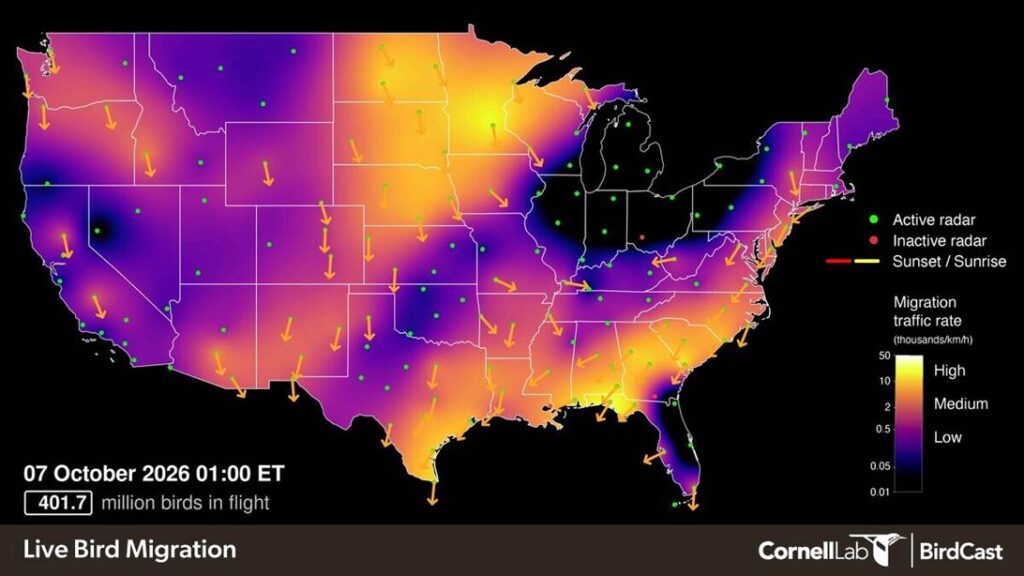
Figure 1. Migrating birds in the air at 1:00 am ET on October 7, 2026. Source: Bird Cast.
The USDA recently updated their HPAI response goals and depopulation policy. The information below is taken from that response document to inform clientele about current policies and procedures.
Currently, the USDA Animal and Plant Health Inspection Service (APHIS) goals for a HPAI response are to (1) detect, control, and contain HPAI in poultry as quickly as possible; (2) eradicate HPAI virus using strategies to protect public health and the environment, and stabilize animal agriculture, the food supply, and the economy; and (3) provide science- and risk-based approaches and systems to facilitate continuity of business for non-infected animals and non-contaminated animal products. Achieving these three goals will allow individual poultry facilities, states, tribes, regions, and industries to resume normal production as rapidly as possible. The objective is to allow the United States to regain disease-free status without the response effort causing more disruption and damage than the disease outbreak itself.
The United States’ primary control and eradication strategy for HPAI in domestic poultry, as defined by international standards and the World Organisation for Animal Health (WOAH), is “stamping-out.” “Stamping-out” is defined in the WOAH Terrestrial Animal Health Code (2022) Chapter 4.19.6 as the “killing of all the animals infected or suspected of being infested, including those that have been directly or indirectly exposed to the casual pathogenic agent… The slaughter or killing of animals should be performed in accordance with Chapter 7.5. or Chapter 7.6., respectively.”
The USDA will continue to evaluate, with states, producers, and industry, the potential use of HPAI vaccine. However, stamping-out of HPAI-infected poultry will always be part of any HPAI response policy, even if a protective vaccination strategy is implemented.
Three basic epidemiological principles form the foundation to control, contain and eradicate HPAI in the U.S. poultry population:
1. Prevent contact between the HPAI virus and susceptible poultry.
a. This is accomplished through quarantine of infected poultry and movement controls in the Infected Zone(s) and Buffer Zone(s) (which comprise the Control Areas), along with biosecurity procedures to protect non-infected poultry.
b. Certain circumstances may warrant accelerating the depopulation or euthanasia of poultry at risk for exposure to HPAI to decrease the population density of susceptible poultry.
c. There is a serious transmission risk posed by people, material, conveyances, and animals that may have been in contact with HPAI and serve as mechanical vectors. Contact between poultry and these items should be prevented, and transmission risk mitigated through stringent biosecurity and cleaning and disinfection measures.
2. Stop the production of HPAI virus by infected or exposed animals. This is accomplished by rapid mass depopulation (and disposal) of infected and potentially infected poultry.
3. Increase the disease resistance of susceptible poultry to the HPAI virus or reduce the shedding of HPAI in infected or exposed poultry. This may be accomplished by strategic emergency vaccination if a suitable vaccine is available and can be administered in a timely manner.
Biosecurity remains our best defense against HPAI. Much of biosecurity is simple common sense, especially if you have spent much time around chickens. If you are new to chickens, biosecurity is one of the first things you need to learn. There are three components to a good biosecurity program, and all are critical to protecting your flock…isolation, traffic control, and sanitation. You must practice all three to have a good biosecurity program. Otherwise, you are putting your flock at greater risk of disease. If you frequent locations other poultry growers frequent (the parts store, poultry supply store, feed store or co-op, local coffee shop or café, etc.), you should take a shower and change clothes and boots when you get home before you go check the chickens. Don’t track something you picked up in town back to your flock.
Keep a visitor’s log of everyone that has been around your birds. For the best protection of your flock, that logbook should have very few names in it. The greater the traffic flow around your birds, the greater the disease risk. Clean and disinfect everything and everyone. Use hand sanitizer and footbaths. Dedicate boots in each control room that are only worn inside the chicken house or use disposable boots in each house and change boots between houses. Do not track something inside that you may have picked up walking between houses. Remember, the virus is in the manure of infected birds. If you unknowingly walk through HPAI infected manure and track it into the poultry house or coop or pen, you have put HPAI there, and it will spread from there. Developing, maintaining, and constantly improving a proper biosecurity plan for your farm as a preventative against HPAI will be much less expensive and less stressful and will require less time and labor than dealing with an avian influenza break. Biosecurity is not a sure-fire, ironclad, 100 percent guarantee that your flock will not get avian influenza, but for now, it’s the best defense we have.