Justin Niyongabo
Master’s Student
Agricultural Leadership, Education and Communications
Smith Center for International Sustainable Agriculture University of Tennessee Institute of Agriculture
Highly pathogenic avian influenza (HPAI) is a type of avian influenza that affects poultry such as chickens and turkeys, and it can also affect numerous wild birds, particularly waterfowl. HPAI is very lethal. It can cause severe mortality in a flock once infection has been confirmed. HPAI has been known to cause as much as 95-100% mortality, and there is no cure or vaccine yet. There are many ways that HPAI can be introduced on a farm, and they include people, vehicles, contaminated feed, footwear, and many others. The most common source of contamination is through some form of contact with wild birds.
HPAI is not a recent issue. In 2014-2015, the first major outbreak of HPAI happened in the US. 50.5 million birds were lost or euthanized because they had contracted HPAI. The direct financial loss of this outbreak was estimated at 1.6 billion US Dollars. The wide economic impact was estimated at 3.3 billion US Dollars. During the current outbreak, USDA has confirmed that 209 million birds have been affected by HPAI since the outbreak started in 2022. These numbers show that there are harsh financial consequences that come with an HPAI outbreak, and it is why proper biosecurity is necessary to reduce the risks associated with an outbreak.
Before discussing proper biosecurity, we should first discuss what causes an outbreak and how an infection happens. An infection happens in stages.
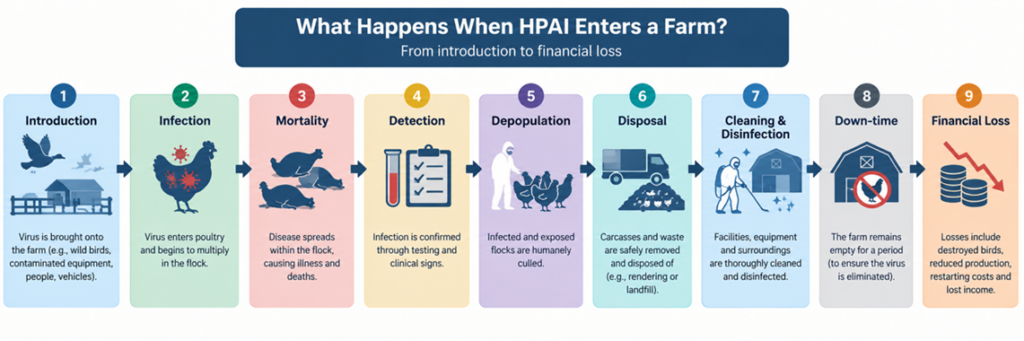
Adapted from USDA (2016).
- Introduction: This is the first step of an outbreak. Modern farms have extensive protection and protocols that prevent outbreaks, but they are still susceptible to infections through different means such as vehicles, feed, and people. The most common infection agents are wild birds such as wild waterfowl. Free-range birds are the most at risk here, although commercial poultry are still susceptible through other means, such as contaminated feed and vehicles or the virus being tracked into the poultry house.
- Infection: Bird-to-bird infection spreads through respiratory secretions. It can also spread through shared water, feces, and air. The infection spreads fast. It has been known that in as little as 48 hours, an entire flock will be affected with staggering levels of mortality.
- Mortality: This is where things get serious. Mortality levels can be higher than 90%; sometimes they can be as high as 100%. In addition to the rising mortality, birds have a decreased appetite, reduced water intake, head/comb/wattle swelling, and a collapse in egg production.
- Detection: After the high mortality, the next step is detection and confirmation of the outbreak. Farmers are legally required to disclose events like this. An outbreak can only be confirmed through laboratory tests such as a rapid antigen test or PCR at a national/regional veterinary diagnostic lab.
- Depopulation: Once an outbreak has been confirmed, in this stage, the remaining birds are “humanely” euthanized to control the spread of the virus. Depopulation can be done using foam, carbon dioxide, or ventilation shut down (under the proper conditions).
- Disposal: This can involve composting on-site, burial, or incineration, under regulatory protocol, to prevent scavengers such as wild birds and rodents from re-seeding the virus into the environment
- Cleaning and disinfection: After all dead birds have been properly disposed of. The next step is cleaning followed by disinfection. First, there should be a full cleanout of litter, manure, eggs (if present), and feed that are all disposed of with the dead birds. Disinfection involves using powerful approved chemicals such as sodium hypochlorite or other disinfectants.
- Downtime: Mandatory empty period before restocking. The period is commonly 14- 28 days post-cleaning, sometimes with sentinel bird testing required before repopulation is approved
- Financial loss: Financial loss compounds across every prior stage: culled-flock value, lost production, disposal and disinfection costs, unpaid downtime, trade/export restrictions, and reputational damage on the market
Now that we have seen the steps that happen from infections all the way to the financial consequences, what can be done to make sure that the chances of HPAI are significantly reduced on a farm? What can be done to make sure that farms do not suffer these losses? What can be done to make sure that egg prices do not rise due to egg shortages caused by HPAI? Biosecurity measures are tailored to risk factors associated with causing infection. HPAI does not have a cure or a vaccine. What can be done is to have preventative measures (proper biosecurity) in place, and that starts by controlling the risk factors associated with the first step of the shared image.
Risk factor 1: Wild birds
- Prevent their access to the poultry house by maintaining doors, repairing holes, and maintaining inlets to prevent wild birds from entering
- Remove standing water from the farm. This water can attract wild birds that want to drink or bathe from it. Alternatively, stagnant water can be an excellent medium for harmful bacteria growth, which are a biosecurity hazard
- Store feed and water in secure containers that restrict access to wild birds
Risk Factor 2: Workers and Visitors
- Restrict visitor access to the farm. If visitors must come to the farm, they should sign a log book with a history of their previous farm visits.
- There should be boots and farm clothes that are specific to each house on a farm. If possible, every farmhouse should have its own employees
- All farm equipment should be cleaned and disinfected regularly. Farm equipment should not be shared with other farms.
Risk Factor 3: Vehicles and Equipment
- Vehicles should generally not be permitted on the farm. There should be a place outside the farm for vehicles to make deliveries
- In cases where vehicles do need to come on the farm, they should be cleaned and disinfected with proper chemicals. Special care and attention should be given to the tires, wheel wells, and undercarriage
Risk Factor 4: Rodents, Feed, and Disposal
- There should be a pest control program at the farm. This program should be written down, and what is written is what should be done. It should include disposal methods for dead pests
- There should be a disposal protocol for dead birds from “normal” day-to-day mortalities
These are just a few of the biosecurity measures that can be implemented to reduce the chances of an HPAI outbreak happening on a farm. Outbreaks can be very costly, and their consequences go well beyond financial. Losing an entire flock can cause emotional distress and reputational damage. Biosecurity is not a one-time inspection or a government checkbox. It is a daily habit repeated every time someone crosses onto your farm.
REFERENCES
- What are the different types of avian influenza? What do the numbers next to H and N mean? USGS. (n.d.). https://www.usgs.gov/faqs/what-are-different-types-avian-influenza-what-do-numbers-next-h-and-n-mean
- Confirmations of highly pathogenic avian influenza in commercial and backyard flocks. Animal and Plant Health Inspection Service. (n.d.). https://www.aphis.usda.gov/livestock-poultry-disease/avian/avian-influenza/hpai-detections/commercial-backyard-flocks
- Green AL, Branan M, Fields VL, Patyk K, et al. (2023), Frontiers in Veterinary Science, doi:10.3389/fvets.2023.1229008 (table egg farm case–control study)
- Patyk, K. A., Fields, V. L., Beam, A. L., Branan, M. A., McGuigan, R. E., Green, A., Torchetti, M. K., Lantz, K., Freifeld, A., Marshall, K., & Delgado, A. H. (2023). Investigation of risk factors for introduction of highly pathogenic avian influenza H5N1 infection among commercial turkey operations in the United States, 2022: A case-control study. Frontiers. https://www.frontiersin.org/journals/veterinary-science/articles/10.3389/fvets.2023.1229071/full
- USDA. (2016). Final report for the 2014-2015 outbreak of highly pathogenic avian influenza (HPAI) in the United States. Veterinary Services Surveillance, Preparedness, and Response Services. APHIS. Available at: https://www.aphis.usda.gov/media/document/2086/file?utm_source+chatgpt.com. Accessed: 10/17/2026.